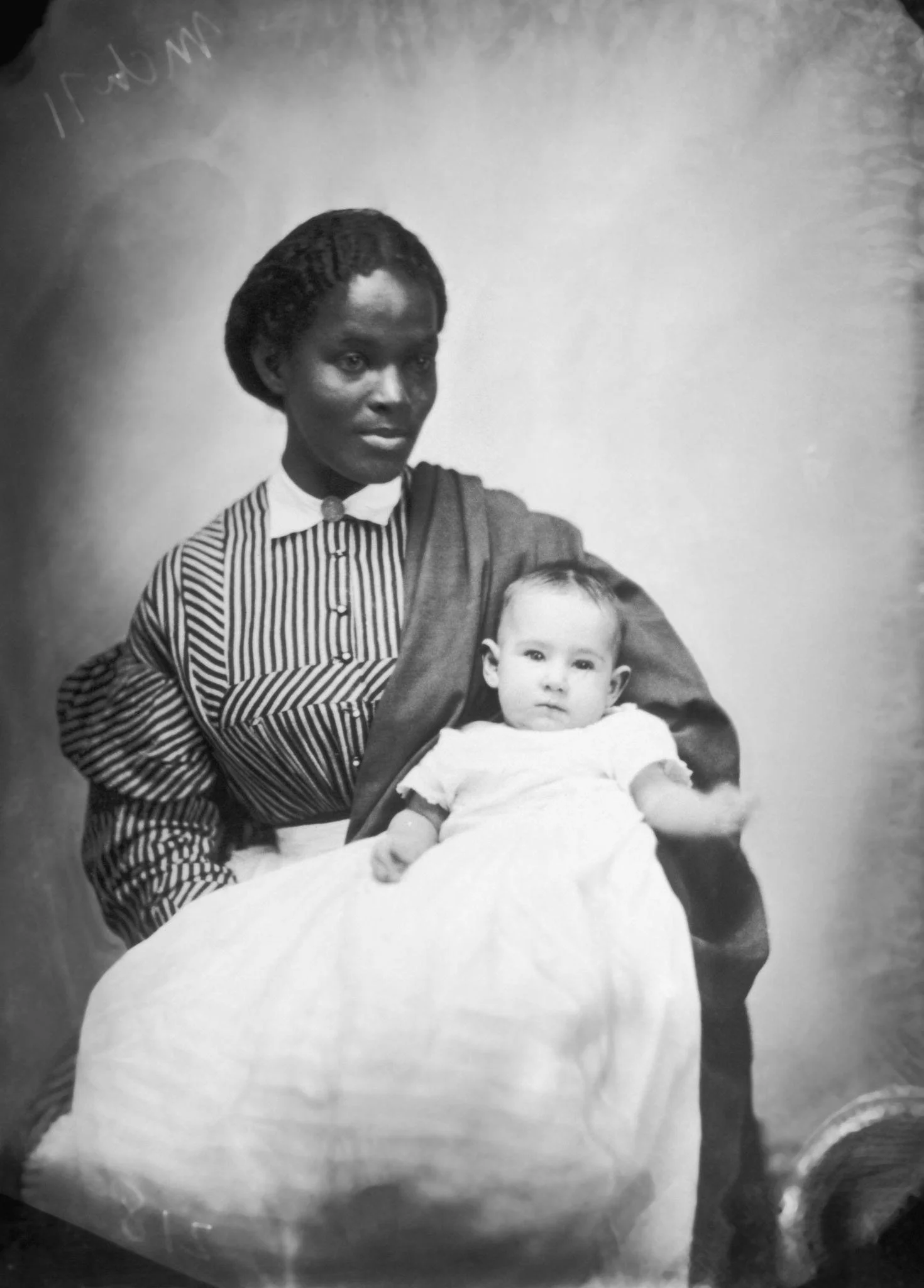
THIS IS THE FOUNDATION OF LACTATION IN THE SOUTH.
For generations, Black women were forced to feed the children of those who enslaved them—while their own children were neglected, sold, or left to starve. Their milk was extracted as labor. Their grief was not recorded. Their expertise was not honored.
Lactation justice begins with telling the truth about this history.
Nursemaid
Before the data.
Before the policy.
Before the statistics.
Before the data. Before the policy. Before the statistics.

A Civil War-era print of an African-American wet nurse - google images.
A MEMORY THAT WAS NEVER WRITTEN INTO RECORD
I wish I dried up
I wish every drop of my milk slipped passed those pink lips and nourished the ground
Where the bones lay
Of my babies
Starved while I feed their murderer
I wish I dried up
So the missus babies would dry up too
And be brittle
So I could crumble them to dust
Return them to the ground
Where all children of my bosom lay equal
— Hess Love
This is part of Southern lactation history.
For generations, Black women were forced to feed the children of those who enslaved them — while their own children were neglected, sold, or left to starve. Their milk was extracted as labor. Their grief was not recorded. Their expertise was not honored.
Lactation justice cannot exist without naming this history.
Lactation history in the Deep South did not end with enslavement.
It evolved into systems that still shape care today.
Wet Nurse Exploitation
For generations, Black women’s milk sustained white families while their own children were deprived of care. Their bodies were treated as resources. Their lactation was extracted without consent, compensation, or protection.
This exploitation laid the groundwork for the devaluing of Black maternal labor — including lactation labor — for generations to come.
Lactation was never “natural and free.” It was controlled.
This was not informal care. It was a controlled system of extraction.
Formula Marketing in Black Communities
Aggressive marketing campaigns targeted Black families throughout the 20th century. Free samples were distributed in hospitals. Formula was marketed as aspirational, convenient, and medically superior.
When breastfeeding rates declined, the decline was not accidental. It was engineered through policy, marketing, and systemic shifts in trust and access.
Communities that had already experienced reproductive exploitation were then repositioned as consumers.
Medicalization of Birth & Feeding
As birth shifted from homes to hospitals in the 20th century, control shifted from midwives to medical institutions. Breastfeeding — once community-supported and culturally embedded — became regulated, scheduled, and sometimes discouraged.
Hospitals introduced rigid feeding schedules. Formula was positioned as modern and scientific. Lactation knowledge that once lived in communities was reframed as secondary to medical authority.
This shift was not neutral. It redefined authority, autonomy, and access.
Systemic Exclusion from Professional Lactation Pathways
Today, Black representation among IBCLCs remains disproportionately low.
Barriers include:
Cost of certification
Limited mentorship access
Clinical hour requirements
Institutional gatekeeping
Geographic disparities in training sites
The result?
Communities most impacted by breastfeeding disparities often have the least access to culturally responsive lactation professionals.
That is not coincidence.
That is structure.
WHY LACTATION JUSTICE REQUIRES HISTORY
Lactation justice is not about romanticizing the past.
It is about understanding how exploitation, medicalization, marketing, and systemic exclusion shaped the present.
If we do not name these systems, we cannot change them.
This is not just history.
This is infrastructure.
Alabama deserves better.
The Deep South deserves repair.
The Latch to Systems Framework™ recognizes that lactation is not an isolated act—it is shaped by history, systems, access, and power.