THE LATCH TO SYSTEMS FRAMEWORK™
Centering Black Families, Fathers, and Gender-Expansive Birthing People Through the Power of Lactation
Lactation is not just feeding support.
It is infrastructure.
The Latch to Systems Framework™ is a systems-based model that advances breastfeeding equity and birth justice by embedding lactation care across the full maternal–infant health continuum.
At The Obsidian Milk Collective, we are shifting the narrative:
Breastfeeding is power. Families are essential. Systems must change.
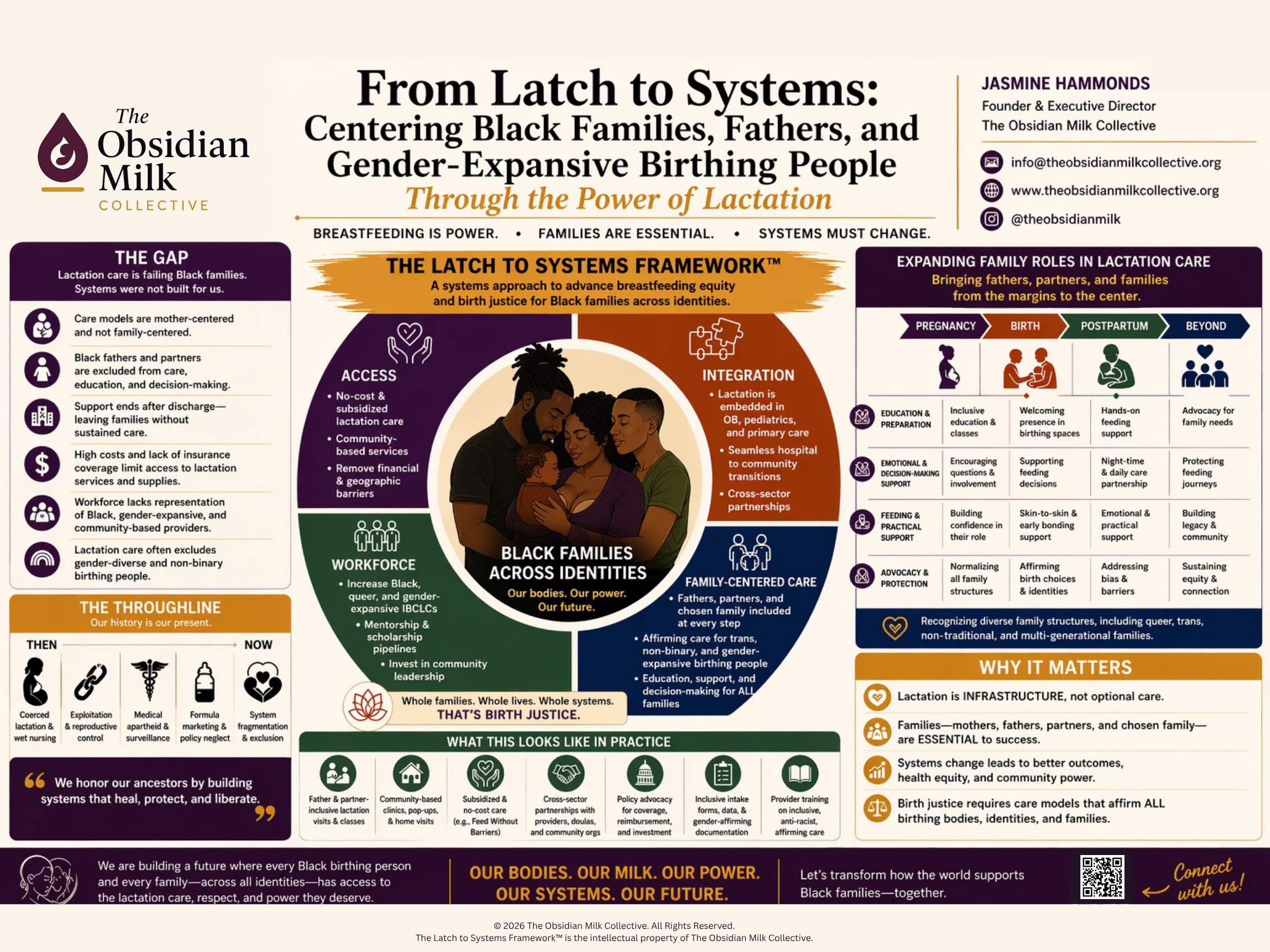
The Latch to Systems Framework™ may not be reproduced, adapted, or used without written permission from The Obsidian Milk Collective.
WHY THIS FRAMEWORK EXISTS (THE GAP)
Lactation is often treated as an individual responsibility.
Families are told:
to try harder
to seek support
to make informed choices
But what happens when:
support is unavailable
care is unaffordable
providers are inaccessible
systems are fragmented
or history has shaped mistrust and inequity
This framework exists to name a truth:
Feeding outcomes are shaped by systems—not just individual behavior.
The Gap
Lactation care is failing Black families—not because of individual choices, but because systems were never built to support them.
Care models are mother-centered, not family-centered
Fathers and partners are excluded from education and decision-making
Support ends after discharge, leaving families without continuity
Insurance barriers limit access to care and supplies
Workforce lacks Black and gender-expansive representation
Care systems exclude non-binary and gender-diverse birthing people
THE CONTINUUM: FROM LATCH TO SYSTEMS
Lactation care is not individual—it is relational.
It includes birthing people, fathers, partners, and chosen family across the full continuum of care. The Latch to Systems Framework™ moves across five interconnected levels of care and influence:
-
The point of contact.
• positioning
• milk transfer
• pain, latch, supply
• immediate postpartum support
This is where most lactation conversations begin.
And it often centers only the birthing person—
while fathers, partners, and support people are left out.
But it is not where care should begin or end.
-
What surrounds the individual—and the family.
• availability of lactation professionals
• affordability of care
• access to pumps and supplies
• transportation and scheduling
Access also determines who is included in care—
fathers, partners, and chosen family members are often excluded from education and support.
Without access, knowledge cannot be applied.
-
Where care is structured.
• hospital practices
• discharge processes
• referral systems
• provider training
• integration into maternal and infant healthcare
Most systems are built around a narrow definition of who lactation support is for—
often excluding fathers, partners, and gender-expansive birthing people.
Continuum of Care (ACCESS + SYSTEMS BRIDGE)
Lactation support is not a single visit—it is a relationship over time.
• Birth (0–72 hours): Initial latch and feeding support
• Early Postpartum (0–6 weeks): Stabilization and assessment
• Ongoing Postpartum (as long as lactation continues): Responsive, developmentally aligned support
Postpartum does not end at 6 weeks.
It continues for as long as a family is feeding.
Care must be continuous—not episodic.
This is where systems either support families—or fail them.
-
What is funded, covered, and prioritized.
• Medicaid coverage for lactation services
• insurance reimbursement
• workplace protections
• public health investment
• legislation and advocacy
Policy determines who has access to care—
and whose families are recognized within it.
Policy shapes what is possible.
-
What we ultimately see.
• breastfeeding initiation and duration
• maternal and infant health outcomes
• chronic disease risk
• disparities across race and geography
When fathers, partners, and gender-expansive birthing people are included,
outcomes improve—for the entire family.
Outcomes are not random.
They are produced—by the systems we build.
HOW THE FRAMEWORK IS APPLIED
The Latch to Systems Framework™ is not theoretical.
It is a tool for systems change.
It is used to:
design programs that address structural barriers
guide funding and resource allocation
inform policy and advocacy efforts
shape workforce development strategies
reframe lactation as essential healthcare
CENTERED, NOT LIMITED
This framework centers Black families in Alabama and the Deep South because that is where gaps in care are most visible.
This is not about exclusion.
It is about clarity.
When we build for those most impacted, we create systems that work better for everyone.
WHAT THIS FRAMEWORK REQUIRES
Improving latch alone is not enough.
Systems must change.
Lactation justice requires:
accessible, affordable care
a representative and supported workforce
integrated healthcare systems
policy that reflects the value of human milk
sustained investment in community-rooted solutions
THE ROLE OF THE OBSIDIAN MILK COLLECTIVE
The Obsidian Milk Collective operationalizes the Latch to Systems Framework™ through: education and narrative change
lactation access funding
workforce development
policy and advocacy
strategic partnerships
OMC exists to build the infrastructure that ensures this framework is not just understood—but implemented.
FINAL STATEMENT
Lactation is not optional support.
It is health infrastructure.
The problem was never just the latch.
The solution cannot be either.
The Latch to Systems Framework™
Developed by Jasmine Hammonds, Founder of The Obsidian Milk Collective